
 Company Profile
 Organization Structure
 Elite Teams
 Qualification Certificates
 Development History
 Social Honors
 Personal Honors
News Center
 Company News
 Tendering and Bidding Announcements
 Commercial residential buildings
 New energy and new materials
 Pulp and Paper Engineering
 Sugar Engineering
 Food and Fermentation Engineering
 Grain Storage, Cold Chain Logistics
 Pharmaceutical Engineering
Sci-tech Innovation
 Achievements
 Digital
 Honorary Awards
Contact Us

Recently, the Department of Housing and Urban-Rural Development of Guangxi Zhuang Autonomous Region officially issued Experience and Practices of Building Information Modeling (BIM) Technology Application Pilot Projects (Phase I). The BIM application achievements of the ClO₂ preparation section in the pulping workshop of Phase I of CNDC Zhihu Yuanchao Household Paper Full Industry Chain Project have been promoted as the first typical case among the initial batch across Guangxi to competent housing and urban-rural development departments at all levels and relevant entities. This honor not only represents authoritative recognition of the project’s BIM practice effectiveness but also fully demonstrates CNDC’s technological leadership and benchmark status in the digitalization of engineering construction.
As an important part of the 2025 BIM technology application pilot launched by the Department of Housing and Urban-Rural Development of the autonomous region, this pilot aims to drive BIM technology from demonstration at selected points to full-chain application, and fully empower the digital transformation of engineering construction. Responding proactively, CNDC selected the ClO₂ preparation section of the pulping workshop—characterized by complex technical systems and high collaboration difficulty—as a breakthrough for in-depth BIM application, taking the lead in carrying out digital collaboration practices covering the whole process of design–construction–operation and maintenance.
During project implementation, the CNDC BIM technical team focused on building a unified data standard and collaborative management platform, breaking down information barriers among all participating parties to achieve efficient collaboration based on the same digital foundation. Through the systematic integration of core BIM applications such as parametric modeling, clash detection, construction simulation, and automatic engineering quantity statistics, design accuracy and construction efficiency have been significantly improved, and risks of engineering changes and rework have been effectively reduced. A highly replicable and promotable BIM implementation path for industrial projects has been formed.
At present, 100% of the company’s general contracting projects conduct digital design on the China Haisum Cloud Factory, and the digital design ratio of construction drawing design projects reaches 80%. The successful selection as one of the first batch of promoted cases in the region marks an important milestone for CNDC in its deep cultivation of digital technologies. Taking this pilot promotion as an opportunity, CNDC will continue to deepen the innovative application of BIM technology in the field of engineering construction, summarize more replicable and promotable practical experience, and contribute to the high-quality development of engineering construction in Guangxi.
Appendix: Experience and Practices of the Pilot Project
ClO₂ Preparation Section of Pulping Workshop, Phase I of Zhihu Yuanchao Household Paper Full Industry Chain Project
I. Project Overview
The Zhihu Yuanchao Household Paper Full Industry Chain Project is invested by Guangxi Zhihu Yuanchao Paper Co., Ltd., located in the Binjiang Area of Binjiang Industrial Park, Gangnan District, Guigang City, with a total land area of 1,805.8 mu and a total investment of approximately 13.7 billion yuan for the main project. Using wood chips, bamboo chips, and slab skins as main raw materials, the project adopts kraft pulping, elemental chlorine-free (ECF) bleaching, alkali recovery, and other processes to produce bleached chemical pulp and household paper. The planned total pulp and paper capacity is 1.26 million tons per year, to be constructed in phases.
The first phase includes a 330,000-ton-per-year bleached chemical pulp production line, and its supporting ClO₂ preparation system is general contracted by China Light Industry Nanning Engineering Co., Ltd. (CNDC), a wholly-owned subsidiary of China Haisum Engineering Co., Ltd. The ClO₂ preparation system adopts internationally leading technology, mainly consisting of three zones: sodium chlorate electrolysis, hydrochloric acid synthesis, and chlorine dioxide absorption. The product is chlorine dioxide solution with a daily capacity of 40 tons.
Led by CNDC, the project was selected as one of the 2025 BIM Technology Application Pilot Projects by the department. The Guigang Municipal Bureau of Housing and Urban-Rural Development conducted regular progress tracking and on-site investigations, guiding the project team to integrate BIM technology with policies for the digital transformation of the construction industry, coordinating rapid approval for project filing, construction permit, and supervision registration, and helping to establish a full-cycle BIM application scenario covering design–construction–operation and maintenance, achieving the expected goals of the pilot project.
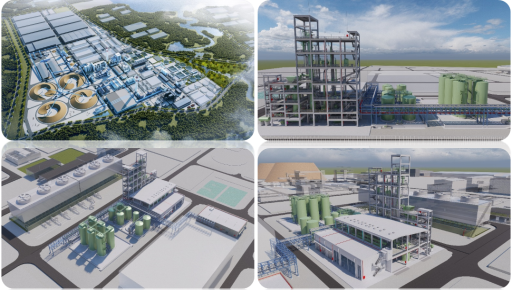
Rendering of the entire plant and the chlorine dioxide production system
I. BIM Technology Application Experience
1. Building a Full-Discipline Enterprise Family Library Supporting Forward Design
The construction of the company’s design family library has gone through three stages:
· Initial Stage: An Engineering Information Management (EIM) Center was established to lead the development of the component library. Limited by low security, poor quality, incomplete attributes, and low reusability of third-party component libraries, it failed to meet the company’s personalized customization needs, restricting BIM design efficiency for the project.
· Second Stage: Full participation in joint construction was promoted to enrich the component library and improve quantity and quality through project accumulation. However, inconsistent rules, standards, and attributes, low parameterization, and frequent application modifications still hindered BIM design efficiency.
· Third Stage: A cloud design library platform was adopted for centralized component management, standardizing library construction rules, component attributes, unified shared parameters, and detailed drawing expression. The parametric family library was reshaped, effectively improving reusability and supporting forward design. A full-discipline BIM design library covering more than 90% of project requirements was formed.
Based on the cloud design library platform, CNDC jointly built and shared the design library with other subsidiaries of the group, facilitating the implementation of the company’s digital design.
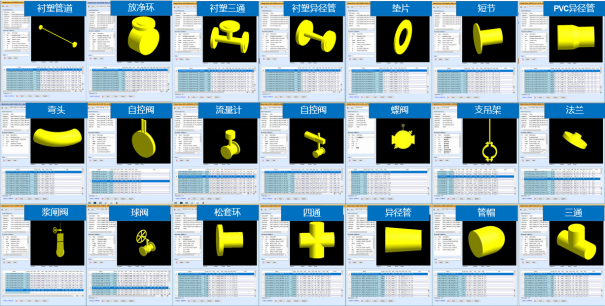
Customised library of process piping components
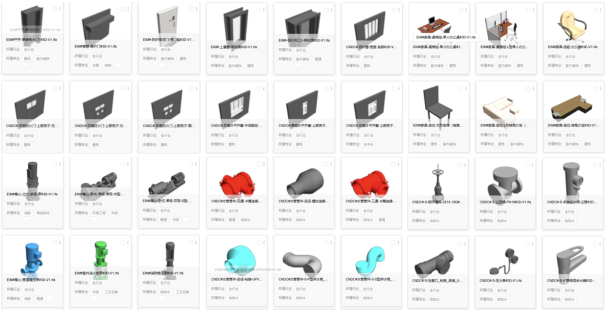
Customised library of civil, mechanical and electrical design
2.Developing Self-Developed Professional Plug-Ins and Tools Targeting Practical Engineering Pain Points
General BIM software serves as a basic platform but struggles to adapt to the personalized needs of industries, enterprises, and disciplines—a key difficulty in BIM promotion. CNDC regards self-developed professional tools as a critical path to deepen BIM application. Self-developed tools mainly include:
(1) Developing Professional Design Toolkits: Focusing on design pain points, the company participated in developing auxiliary modeling and deepening toolkits for various disciplines (civil engineering, water supply and drainage, electrical, HVAC) based on the cloud tool platform, meeting core design modeling needs with multiple cross-disciplinary general functions.
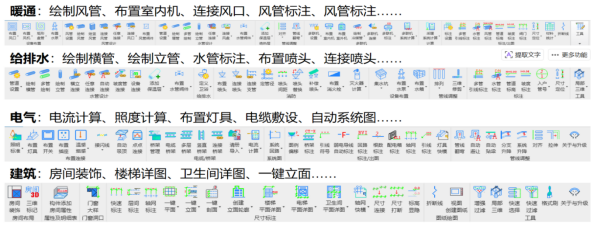
Professional design toolset
(1) Developing Data Interface Tools: To address data interaction barriers among process, civil, and MEP disciplines on different software platforms (causing repeated modeling and inconsistent data), the company independently developed data interface tools to connect models and data across software, along with automatic review and data analysis tools for project management.
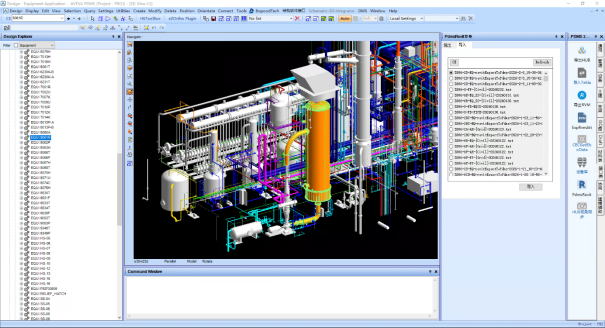
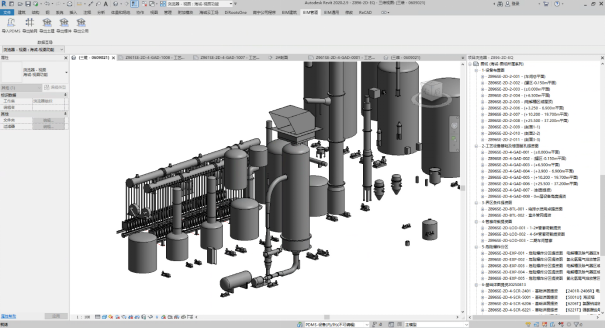
Data interface tool
3.Customizing BIM Project Templates and Standardizing Processes
In line with forward design requirements and combined with the characteristics of light industrial projects, CNDC deeply integrated enterprise standards to customize BIM project templates:
(1) Configuring Basic Environments: Unifying project folder structure, file coding rules, discipline collaboration methods, coordinate systems, grids and elevations, units and precision, and presetting work sets and links for each discipline to define work scopes.
(2) Establishing Parameter Systems: Defining classification rules for project parameters, family parameters, type parameters, and instance parameters, customizing a shared parameter system for cross-platform, cross-discipline, and cross-phase data interaction, and setting parameter association rules to enable data-driven model and drawing updates.
(3) Loading Family Library Resources: Presetting general standard components in project templates by project type, batch-setting system families via intelligent tools reading design specifications, and loading dedicated families from the cloud design library for rapid design resource configuration.
(4) Integrating Drawing Specifications: Customizing project browsers by work breakdown, presetting styles for dimensions, elevations, grids, text, lines, and hatching per drawing standards, and standardizing legends, sections, indexes, and detail symbols.
(5) Customizing View Templates: Formulating view template naming rules, dividing views into working, information submission, and drawing issuance stages, each categorized into plan, elevation, section, and detail. Presetting model accuracy, display styles, filters, and visibility for each view template to enable one-click switching and correct expression.
(6) Presetting Material Schedules: Presetting various schedules for different disciplines (e.g., doors, windows, rooms, fire compartments for architecture), with deeply customized schedules reaching construction drawing depth based on the shared parameter system.
(7) Setting Delivery Standards: Establishing detailed digital design delivery standards, specifying model and information depth, drawing expression, mandatory and optional items for various components, and linking to the model review system for automatic inspection.
4.Conducting Forward Design via Cloud Collaboration for Model-Drawing Consistency
The project applied a digital collaborative design platform to break spatial-temporal and disciplinary barriers, enabling real-time collaboration among multiple participants throughout the process. Design workstations were deployed on the cloud with a unified design environment, supporting compatible switching of multiple software, lossless model information conversion, one-click project creation, and automatic template application. Efficient collaboration was achieved via hyper-converged servers, with full disciplines conducting BIM forward design on the cloud—models generating drawings to ensure consistency—and high-quality BIM data accumulated on the platform as the foundation for intelligent design.
(1) Process, Civil, and MEP Disciplines: Collaborated efficiently on equipment layout, space management, and information exchange. Equipment models were imported into PDMS via data interfaces for complex process piping and support design; thousands of piping isometrics were rapidly batch-produced using the ISO engine; layout drawings were assisted by drawing plug-ins, with material schedules automatically generated.
(2) Architecture and MEP Disciplines: Conducted collaborative modeling, information submission, drawing issuance, and quantity calculation per EIM system documents, improving overall design efficiency and reducing clashes via cloud-enabled cross-regional multi-disciplinary collaboration.
(3) Concrete Structures: Adopted PKPM + BIMBasePlant for integrated modeling–calculation–drawing design.
Upon completion, full-discipline models were converted to lightweight models via plug-ins and published online with one click, supporting subsequent BIM review, digital delivery, smart construction sites, and other applications.
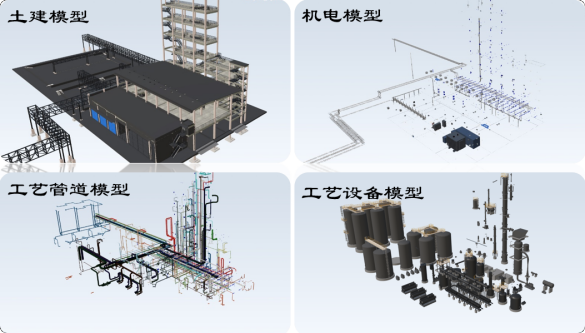
3D models of the various disciplines involved in this project
5. Realizing Online Review via Lightweight BIM Models
The project applied the Cloud HUB platform based on a lightweight 3D engine, allowing all participating parties easy access via web browsers and integrating daily work. Functions including 3D roaming, clash detection, BIM drawing review, model-drawing linkage, and issue management were used to fully control deliverable quality. Based on lightweight BIM models, more than 150 issues were tracked and most resolved before construction, effectively reducing clashes and significantly improving engineering quality.
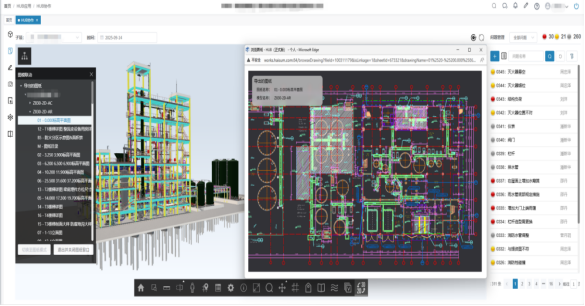
Schematic diagram of online 3D proofreading via a web browser
6.Building a Smart Construction Site Platform for Visualized and Refined On-Site Management
A smart construction site platform was built to manage key indicators including quality, schedule, safety, personnel, materials, and machinery. A project cockpit provided real-time visibility of progress, safety status, resource allocation, and other core information, supporting refined management and rapid decision-making. The project realized data interoperability among progress, BIM models, safety management, and other systems, eliminating information barriers and improving data collaboration efficiency. BIM was applied in the construction phase by connecting lightweight BIM models to the smart platform for model-assisted drawing review, construction organization simulation, 4D schedule management, digital construction monitoring, and as-built model audit and delivery.
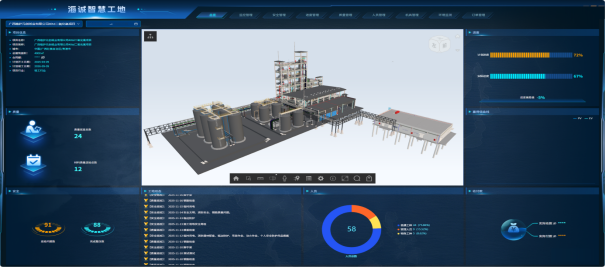
Schematic diagram of smart construction site applications
III. BIM Application Effects
The BIM application of this project has achieved the following results:
1. 20% Shorter Design Cycle: Design efficiency reduced from 10 months to 8 months for similar projects, thanks to resource library reuse, full-discipline collaboration, standardization, and self-developed tools.
2. Over 300 Clashes Eliminated: Automatic positioning and tracking of clashes via the lightweight platform reduced construction rework and material waste.
3. Over 150 Drawing Review Issues Corrected: Web-based 3D online review with 2D-3D linkage and multi-party participation identified hidden issues and reduced construction errors.
4. Support for Piping Prefabrication: Automatic piping isometric generation enabled factory prefabrication and on-site assembly, reducing high-altitude work and shortening piping installation cycles.
5. 20% Higher Structural Design Efficiency: Integrated modeling–calculation–drawing tools, data interfaces, and flat-method drawing feedback eliminated repeated modeling and improved efficiency.
6. Material Accuracy >95%: Improved modeling depth and automatic material schedule generation based on the shared parameter system and enhanced design library information depth reduced waste